There are a hundred and fifty psalms and most people can name three. When you are frightened at two in the morning, or angry at somebody who deserves it, or so tired you cannot pray, the problem is not that scripture has nothing to say. The problem is that you do not know where it is.
This is a short study on how to find the psalm you need — by what you are carrying, by what kind of song it is, or by spinning a wheel and letting it hand you one. Everything described here is free, on this site, with no account and nothing to install.
Open the Psalms · See all 150 on one map
Which psalm should I read?
It is the most common question people ask about this book, and the honest answer is that it depends entirely on why you are asking. The Psalms are not a smooth devotional. They are a collection of songs written by people in wildly different conditions, and the one that will carry you through a funeral is not the one that will carry you through a harvest.
So the first thing worth knowing is what is actually in there.
What the book is made of
One hundred and fifty psalms, two thousand four hundred and sixty-one verses, divided into five books. Sorted by the kind of song each one is, the shape of the collection looks like this:
| Kind | How many | What it is |
|---|---|---|
| Lament | 65 | Complaint. Trouble brought to God and named out loud. |
| Praise | 37 | God for who he is, not for what he has just done. |
| Thanksgiving | 15 | God for something specific he has just done. |
| Trust | 12 | Quiet confidence, usually written in trouble, not after it. |
| Royal | 11 | The king — and beyond him, the King. |
| Wisdom | 10 | Two roads, and how each one ends. |
Sixty-five of the hundred and fifty are complaints. That is the single most useful fact in this study. Nearly half of the church’s oldest hymn book is people telling God that something is wrong. If you have ever felt that your prayers were too bitter to be holy, the Psalms disagree with you at length.
Twelve doors, by what you are carrying
Rather than make you guess, the Psalms room is arranged by need. Each door opens onto the psalms that fit it, with a line on why each one belongs there.
| If you are… | Door |
|---|---|
| Afraid — fear, danger, dread | Psalms for when you are afraid |
| Anxious — worry, racing thoughts | Psalms for anxiety |
| Grieving — loss, sorrow, mourning | Psalms for grief and loss |
| Alone — loneliness, abandonment | Psalms for loneliness |
| Guilty — sin, repentance, shame | Psalms of repentance |
| Angry — anger, injustice, betrayal | Psalms about anger |
| Worn out — exhaustion, burnout | Psalms for when you are weary |
| Thankful — gratitude, testimony | Psalms of thanksgiving |
| Needing hope — waiting, endurance | Psalms of hope |
| Needing direction — decisions | Psalms for guidance |
| Wanting to worship — praise, wonder | Psalms of praise and worship |
| Unable to sleep — night, insomnia | Psalms for the night |
And a wheel, for when you do not know what you need
Some days you cannot name it. You know something is wrong, or something is owed in thanks, and you could not say which door to walk through.
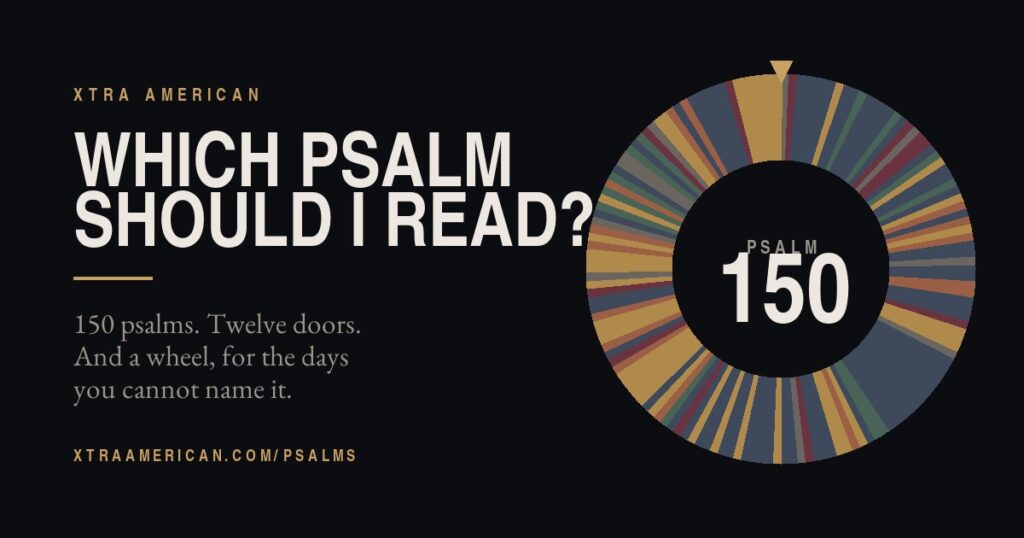
So there is a wheel. One hundred and fifty slices, each coloured by the kind of psalm it is, so the ring itself is a picture of the whole book — and you can see at a glance how much of it is lament. Spin it and it stops on one, tells you what kind it is, gives you a line on what it is about, and opens it.
It is on the front page of this site and inside the free app. It is not a fortune-teller and it does not know anything about your day. It is a way of being handed a psalm you would not have chosen, which is most of them.
Is it right to open the Bible at random?
Worth facing honestly, because people have done strange things with this.
Opening a book at random and treating whatever your finger lands on as a personal message from God is not a practice scripture teaches, and it has led people into real trouble. The verse that lands is not a telegram. It does not know you are deciding whether to take the job.
What a random psalm is good for is simpler and older: it breaks the habit of returning to the same four passages. Most of us have a small private canon — a psalm for comfort, a psalm for praise, and whatever we memorised as children. A wheel will give you Psalm 88, which ends in darkness and offers no resolution at all, and you would never have picked that. Reading it is good for you anyway.
So: use it to be taken somewhere unfamiliar, and read what you land on in its own context, in full. Not as a verdict on your week.
Where to start, if you want a plain answer
People searching for a psalm usually want a specific one named. Here are the ones most often reached for, and what they are actually doing:
- Psalm 23 — the shepherd, the valley, the table. Comfort, but notice the table is set in the presence of enemies, not after they are gone.
- Psalm 51 — the repentance psalm. Written after the worst thing David ever did.
- Psalm 91 — refuge and protection. Reached for in danger and in illness.
- Psalm 121 — a song for the road. Short, and almost entirely promise.
- Psalm 139 — being known completely, and there being nowhere to go from it.
- Psalm 88 — the one nobody recommends. It ends with the word darkness and does not resolve. It is in the book on purpose.
Common questions
What psalm should I read when I am anxious?
Start with the anxiety door. Psalm 94:19 is the line people come back to: In the multitude of my thoughts within me thy comforts delight my soul. The multitude of my thoughts — a fair description of two in the morning.
What psalm should I read when I am angry?
The anger door. The Psalms do not ask you to calm down before you speak. Several of them are furious, and they are still prayer.
Which psalm is for grief?
The grief door. Lament is the largest category in the book by a wide margin — sixty-five psalms — so there is more here than anywhere else.
Is there a psalm for when I cannot sleep?
Yes, and it is a door of its own: psalms for the night. Psalm 4:8 and Psalm 63 were both written for the dark.
How many psalms are there, and who wrote them?
One hundred and fifty. More are associated with David than with anyone else, but the book is not his alone — Asaph, the sons of Korah and others are named too, and a good number carry no name at all. It was gathered over centuries rather than written in one sitting, which is why the moods sit so oddly beside each other.
What is Selah?
Nobody is certain. The word appears seventy-one times in the Psalms — out of eighty-two in the whole Bible — and the most common reading is a musical direction: a pause, or a lift. It is one of the few words in scripture that has never been translated, because no one can agree what it means. Both numbers were counted out of the King James text on this site rather than remembered.
Read them free
All one hundred and fifty are on this site in the King James text, with a line of plain English on what each one is doing, the kind it belongs to, and a way to keep the ones you want to come back to.
- The Psalms — twelve doors, the five books, and a psalm for today
- The map of all 150 — colour is the kind, width is the length. The whole book in one picture.
- The wheel — on the front page. Spin it and read what it gives you.
- XA Daily — the free Bible app, with the Psalms in it and a prayer list
Free, no account, nothing to install, and nothing asked of you.