Tap any reference to open that chapter in XA Daily — free, no account.
There is more sport in the Bible than most people expect, and nearly all of it comes from one man writing to one city.
Corinth hosted the Isthmian Games. They ran every two years and were second in prestige only to the Olympics, and the city was full of them — the training, the crowds, the arguments about who should have won. When Paul wrote to the Corinthians and reached for a picture, he reached for the thing outside their window.
He was not being decorative. He picked the images carefully, and several of them are sharper than they look in English.
The race

1 Corinthians 9:24 — Know ye not that they which run in a race run all, but one receiveth the prize? So run, that ye may obtain.
The first thing to say is that this is not about beating other Christians. Paul is not saying only one of you gets in. He is using the effort of a sprinter, not the scarcity of the prize. So run, that ye may obtain — run like someone who means to finish.
1 Corinthians 9:25 — And every man that striveth for the mastery is temperate in all things. Now they do it to obtain a corruptible crown; but we an incorruptible.
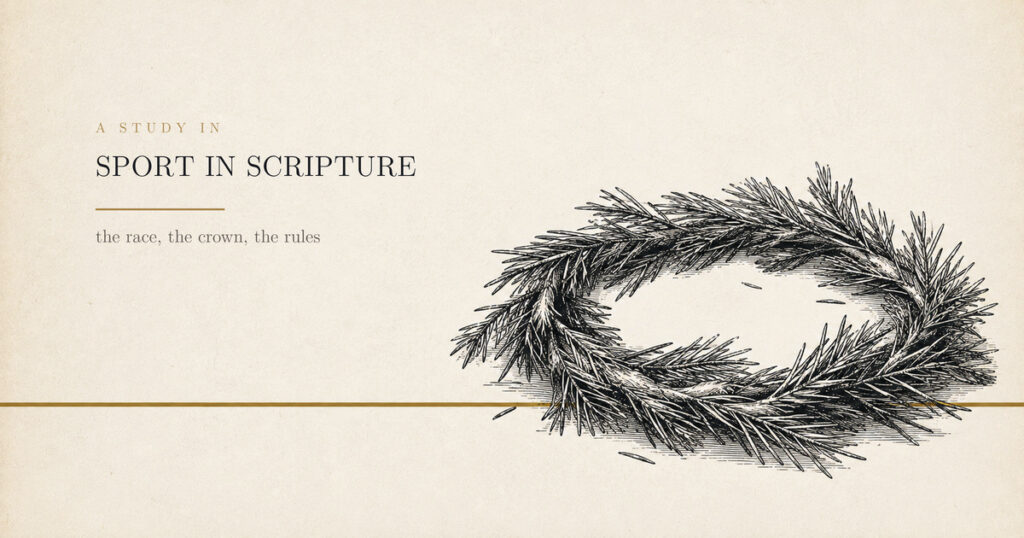
Here is the detail worth having. The prize at the Isthmian Games was not gold. It was a wreath — woven from pine, or in some years from wild celery. A crown that started dying the moment it was cut.
Paul’s audience had watched men give up years of their lives training for a circle of leaves. A corruptible crown is not a figure of speech to them. It is a description of what they saw handed over at the finish.
The word behind striveth
Every man that striveth for the mastery translates the Greek agonizomai. It comes from agon, the contest itself — and it is where English gets agony.
That is what the word for competing became in our language. Not glory. Agony.
Is temperate in all things is the athlete’s discipline: diet, sleep, training, for months, in private, where nobody claps.
The boxing
1 Corinthians 9:26 — I therefore so run, not as uncertainly; so fight I, not as one that beateth the air:
Paul switches sport mid-sentence. So fight I, not as one that beateth the air — the image is a boxer throwing punches at nothing. Shadow-boxing, or worse, swinging wildly and connecting with none of it.
Ancient boxing was brutal. There were no rounds and no ring; the fight ended when a man went down or put his hand up. Fighters wrapped their hands in leather, and by the Roman period sometimes worse.
1 Corinthians 9:27 — But I keep under my body, and bring it into subjection: lest that by any means, when I have preached to others, I myself should be a castaway.
I keep under my body is one word in Greek: hupopiazo, literally to strike under the eye — to give someone a black eye. Paul says he does that to himself.
And castaway is adokimos, the word for a competitor disqualified by the judges. Not beaten. Ruled out.
The rules
2 Timothy 2:5 — And if a man also strive for masteries, yet is he not crowned, except he strive lawfully.
Strive for masteries here is athleo. That is the word English took for athlete.
Athletes at the Greek games swore an oath before they competed and trained under supervision for ten months beforehand. Break the terms and it did not matter how fast you were. There was no crown for winning the wrong way.
The finish
2 Timothy 4:7 — I have fought a good fight, I have finished my course, I have kept the faith:
Three images in one line, and two of them are sport. Fought a good fight — the contest. Finished my course — the race, run to the end. Kept the faith — the oath he swore before he started.
This is the last letter we have from him.
2 Timothy 4:8 — Henceforth there is laid up for me a crown of righteousness, which the Lord, the righteous judge, shall give me at that day: and not to me only, but unto all them also that love his appearing.
A crown of righteousness, against a wreath of pine. He has been carrying that comparison for years.
The crowd
Hebrews 12:1 — Wherefore seeing we also are compassed about with so great a cloud of witnesses, let us lay aside every weight, and the sin which doth so easily beset us, and let us run with patience the race that is set before us,
A stadium image, and the detail is lay aside every weight. Runners at the Greek games trained carrying extra weight and stripped it off before the race. The word for weight, ogkos, means bulk — not sin, just excess. Things that are not wrong, only heavy.
Notice too what the cloud of witnesses is doing. They are not spectating for entertainment. Chapter 11 has just listed them, and every one finished their own leg without seeing the end.
And run with patience settles the distance. This is not a sprint. The Greek hupomone means endurance under load.
The other references
Paul goes back to the track more than once.
Galatians 5:7 — Ye did run well; who did hinder you that ye should not obey the truth?
Who did hinder you is a track term — cutting in on a runner and breaking his stride. He is asking who stepped into their lane.
Philippians 3:14 — I press toward the mark for the prize of the high calling of God in Christ Jesus.
The mark is the skopos, the fixed point a runner keeps his eyes on. You do not look at your feet.
Acts 20:24 — But none of these things move me, neither count I my life dear unto myself, so that I might finish my course with joy, and the ministry, which I have received of the Lord Jesus, to testify the gospel of the grace of God.
1 Timothy 4:8 — For bodily exercise profiteth little: but godliness is profitable unto all things, having promise of the life that now is, and of that which is to come.
That last one gets quoted as though Paul disliked exercise. He plainly did not — he wrote everything above. Profiteth little is a comparison, not a dismissal. Bodily training has a return; it is just a smaller one than the other.
Before the Greeks
The Old Testament has no organised sport — the Greek games arrived in Israel much later, and they were controversial when they did. But there is competition in it.
Jacob wrestles
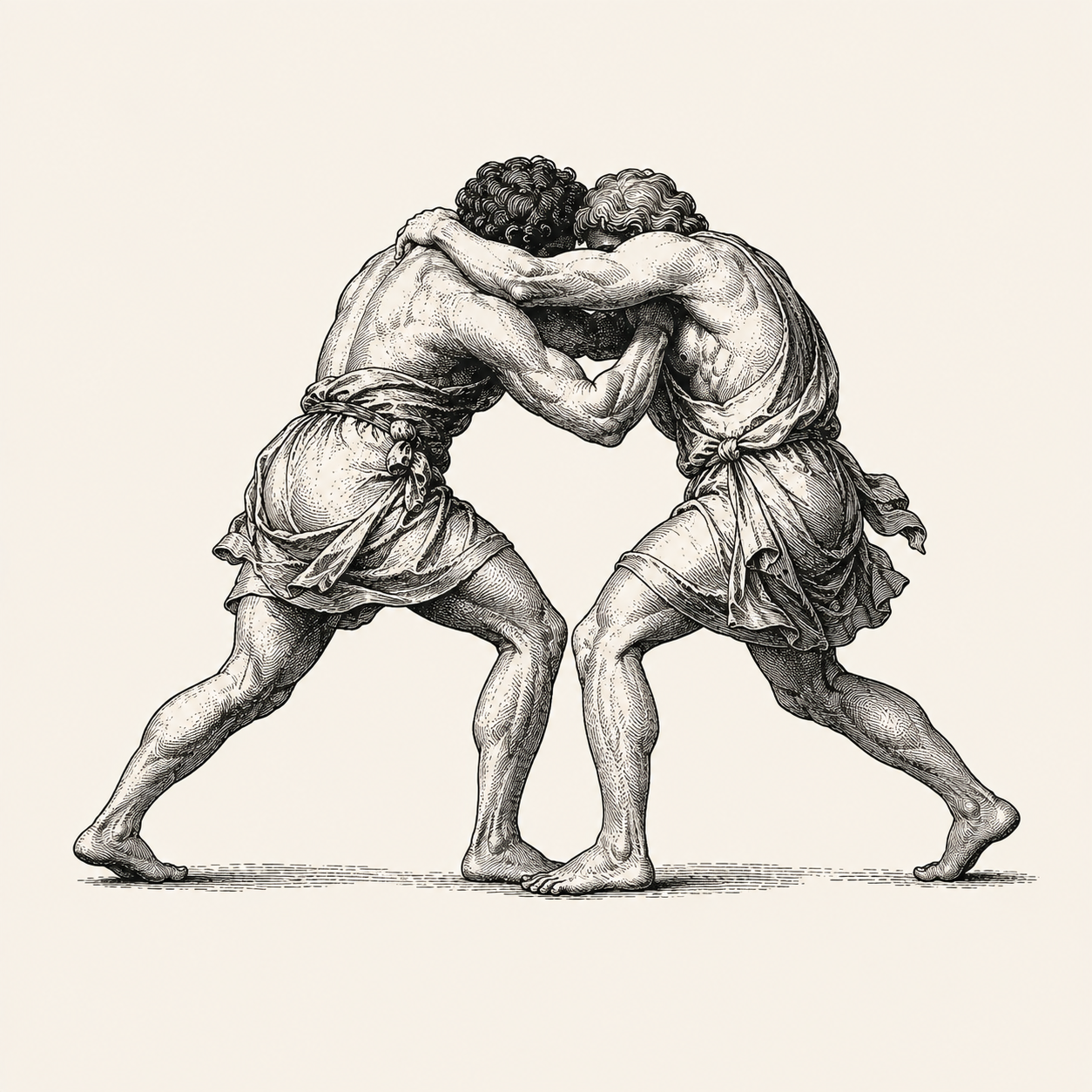
Genesis 32:24 — And Jacob was left alone; and there wrestled a man with him until the breaking of the day.
Genesis 32:25 — And when he saw that he prevailed not against him, he touched the hollow of his thigh; and the hollow of Jacob’s thigh was out of joint, as he wrestled with him.
A whole night, and the man does not overpower him — he dislocates his hip instead, and Jacob still refuses to let go. He walks with a limp for the rest of his life and gets a new name out of it.
The contest at Gibeon
2 Samuel 2:14 — And Abner said to Joab, Let the young men now arise, and play before us. And Joab said, Let them arise.
Play before us sounds harmless. Twelve men from each side were chosen, and every one of the twenty-four died. It is the darkest sporting reference in scripture, and it is a warning about what happens when a contest is used to settle something a contest cannot settle.
David’s sling
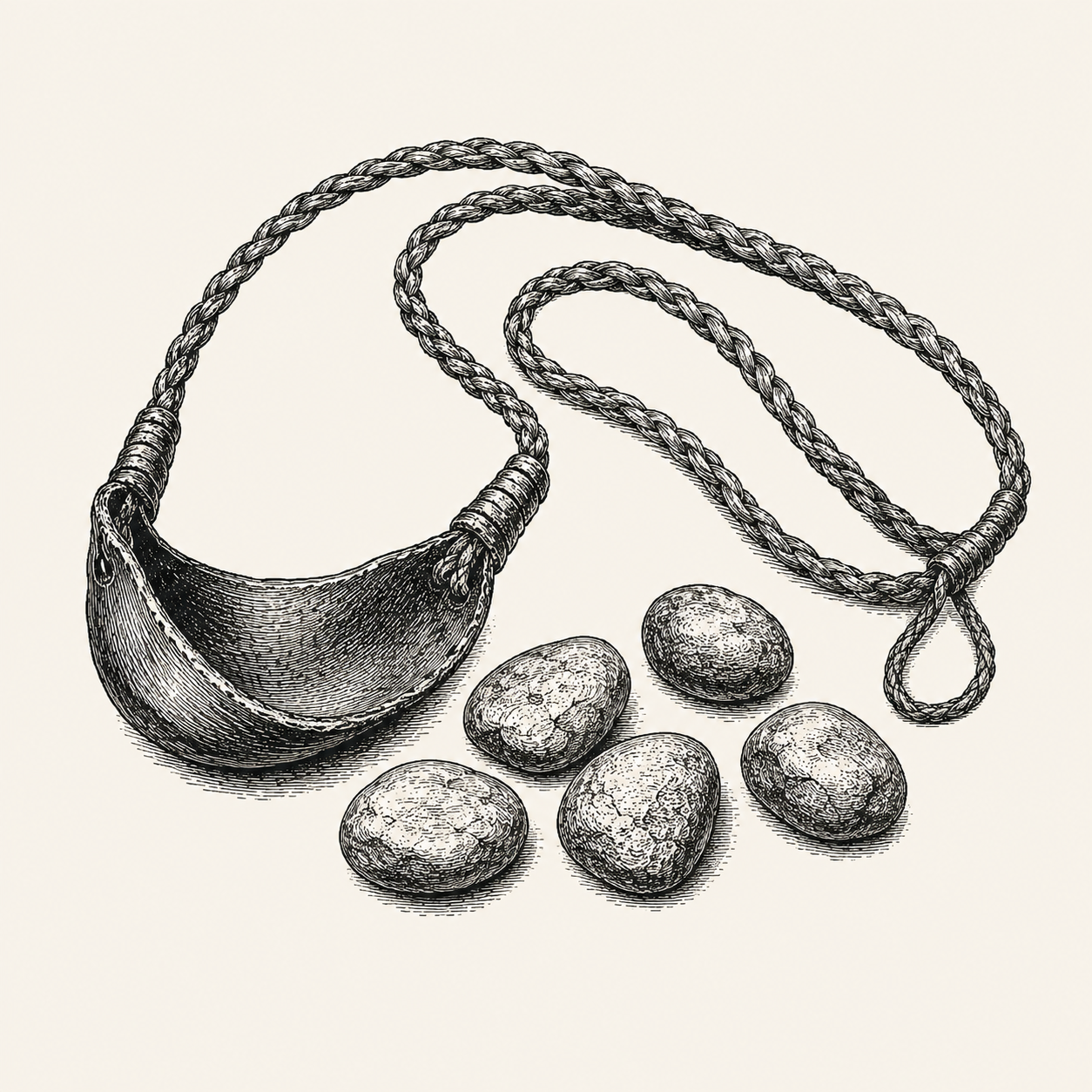
1 Samuel 17:40 — And he took his staff in his hand, and chose him five smooth stones out of the brook, and put them in a shepherd’s bag which he had, even in a scrip; and his sling was in his hand: and he drew near to the Philistine.
Five stones, chosen. A sling in trained hands was an accurate weapon at distance, and shepherds practised with them for years. What looks like a boy getting lucky is a specialist using the one skill he had spent his childhood on.
The verse that balances it
Ecclesiastes 9:11 — I returned, and saw under the sun, that the race is not to the swift, nor the battle to the strong, neither yet bread to the wise, nor yet riches to men of understanding, nor yet favour to men of skill; but time and chance happeneth to them all.
Paul says run to win. Ecclesiastes says the fastest man does not always win, and both are in the same book.
That is not a contradiction. One is about how you run; the other is about what you are owed for it. Train like it depends on you, and hold the result loosely.
What the sport is for
Read them together and Paul is not really talking about winning. He is talking about the parts nobody watches.
The months of temperance before the games. The weight carried in training and dropped at the line. The oath sworn before anyone is watching. The refusal to swing at air.
The crown gets one mention. Everything else is about the work that happens before the crowd arrives.
Every verse here opens in XA Daily, which carries the whole King James Bible, searchable, alongside a Hebrew word each morning and room to write. Free, no account, works offline.