Tap any reference to open that chapter in XA Daily — free, no account.
Scripture is full of animals, and almost none of them are decoration. When the Bible reaches for a creature it is usually because the creature does something a sentence could not do on its own.
This is a walk through the main ones, what the text actually says about them, and what the animals are really like.
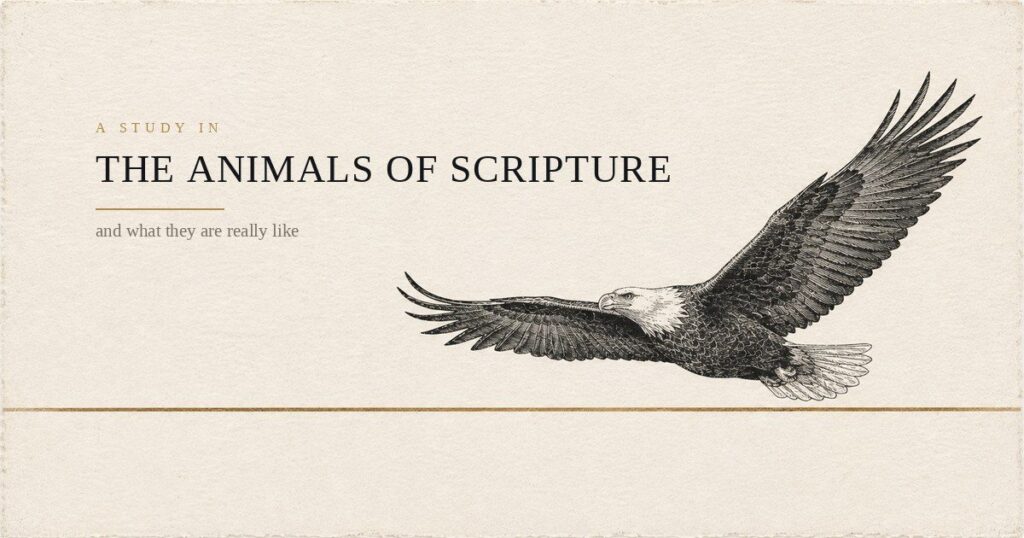
The eagle

Isaiah 40:31 — But they that wait upon the LORD shall renew their strength; they shall mount up with wings as eagles; they shall run, and not be weary; and they shall walk, and not faint.
Isaiah does not say the eagle renews itself. He says they that wait upon the LORD shall renew their strength. The renewing was never the bird’s doing — but the picture he reaches for is exact, and worth knowing.
What eagles do
Golden eagles have been tracked at around twenty thousand feet — near four miles up. They hunt far lower, usually somewhere between a thousand and ten thousand feet, but the ceiling is genuinely extraordinary.
And here is the part that matches the verse. They do not climb by flapping. They find a thermal, a column of warm air rising off ground the sun has heated, and they open their wings and circle inside it. The air does the lifting. They can gain hundreds of feet without a single wingbeat.
That is what mount up with wings as eagles is describing. Not effort. Waiting on a current that is already rising, and being carried.
Exodus 19:4 — Ye have seen what I did unto the Egyptians, and how I bare you on eagles’ wings, and brought you unto myself.
The ox

Proverbs 14:4 — Where no oxen are, the crib is clean: but much increase is by the strength of the ox.
This is one of the most practical verses in the Bible and it almost never gets preached. An empty stall stays tidy. It also produces nothing. If you want the harvest you accept the animal, and the animal makes a mess.
Anything worth doing comes with mess attached. Wanting the increase without the ox is wanting a clean barn and calling it farming.
Isaiah 1:3 — The ox knoweth his owner, and the ass his master’s crib: but Israel doth not know, my people doth not consider.
And there is the sting. The ox knows who feeds it. That is the low bar Israel is being measured against, and missing.
The unicorn, which was not a unicorn

Numbers 23:22 — God brought them out of Egypt; he hath as it were the strength of an unicorn.
The King James says unicorn, and it is not talking about the horse with a horn from a storybook.
The Hebrew word is re’em. The old Greek translation rendered it monokeros, one-horn. The Latin took that as unicornis, and the English translators inherited it. Most scholars now think the re’em was the aurochs — a huge wild ox that once ranged across Europe and the Near East, standing nearly six feet at the shoulder.
It was not mythical. It was hunted to extinction, and the last known one died in a Polish forest in 1627.
Which makes the verse land differently. God did not bring Israel out of Egypt with the strength of a fairy tale. He brought them out with the strength of the largest and most dangerous animal those people had ever seen.
The four small things
Proverbs 30 has a short list of creatures singled out for being tiny and clever. It is one of the strangest and best passages in the book.
The ant

Proverbs 30:25 — The ants are a people not strong, yet they prepare their meat in the summer;
Harvester ants really do gather seed through the warm months and store it underground against the dry season. Proverbs 6:6 sends you to watch them: Go to the ant, thou sluggard; consider her ways, and be wise. The lesson is not strength. It is timing.
The coney

Proverbs 30:26 — The conies are but a feeble folk, yet make they their houses in the rocks;
This is the one almost nobody knows. The coney is the rock hyrax — a stocky little animal about the size of a rabbit, maybe eight pounds, that lives in colonies in cliff crevices across Israel and Africa.
It looks like a guinea pig. It is not a rodent. Its closest living relatives are elephants and manatees. Same branch of the mammal family tree, and you can see it in the teeth and the feet if you know to look.
So the picture is a creature with no speed, no size and no weapons, whose entire survival strategy is living in the rock. It is feeble and it knows it, and that is exactly why it is safe.
The locust

Proverbs 30:27 — The locusts have no king, yet go they forth all of them by bands;
Desert locusts spend most of their lives as ordinary solitary grasshoppers, avoiding each other. When crowding passes a threshold, they physically change — colour, body shape, behaviour — and become gregarious, swarming in their millions.
Nobody gives the order. There is no locust in charge. The order emerges from the crowd, which is precisely what the proverb noticed thousands of years before anyone could explain the mechanism.
The spider
Proverbs 30:28 — The spider taketh hold with her hands, and is in kings’ palaces.
No invitation, no permission. It simply takes hold and ends up somewhere far above its station. Four creatures, none of them strong, all of them somewhere they had no business reaching.
The lion, twice
The lion is the one animal scripture uses for both sides.
Revelation 5:5 — And one of the elders saith unto me, Weep not: behold, the Lion of the tribe of Juda, the Root of David, hath prevailed to open the book, and to loose the seven seals thereof.
1 Peter 5:8 — Be sober, be vigilant; because your adversary the devil, as a roaring lion, walketh about, seeking whom he may devour:
Same animal, opposite meanings. Worth noticing what separates them. Peter’s lion is roaring and walketh about — noise and prowling, looking for something to take. John’s Lion has prevailed. It is already done.
One is making a lot of sound while it hunts. The other has finished and does not need to.
Proverbs 28:1 — The wicked flee when no man pursueth: but the righteous are bold as a lion.
And then the Lamb

Here is the turn that makes Revelation 5 what it is. John is told to look at the Lion. He looks — and one verse later:
Revelation 5:6 — And I beheld, and, lo, in the midst of the throne and of the four beasts, and in the midst of the elders, stood a Lamb as it had been slain, having seven horns and seven eyes, which are the seven Spirits of God sent forth into all the earth.
Promised a Lion, shown a Lamb. Not instead of — the same one. And not a lamb in general, but a Lamb that has been killed and is standing.
John 1:29 — The next day John seeth Jesus coming unto him, and saith, Behold the Lamb of God, which taketh away the sin of the world.
Isaiah 53:7 — He was oppressed, and he was afflicted, yet he opened not his mouth: he is brought as a lamb to the slaughter, and as a sheep before her shearers is dumb, so he openeth not his mouth.
Of all the animals in scripture, this is the one Jesus is given. Not the eagle, not the lion first, not the ox. The animal with no defence at all.
The hind

Habakkuk 3:19 — The LORD God is my strength, and he will make my feet like hinds’ feet, and he will make me to walk upon mine high places. To the chief singer on my stringed instruments.
A hind is a female deer, and the detail behind the image is precise. Deer place each back hoof directly into the print the front hoof just made. It is called direct registering, and it means the back foot lands somewhere already proven to hold.
On broken rock at speed, that is the difference between running and falling. Habakkuk wrote this at the end of a book about watching his nation collapse. Hinds’ feet are not for easy ground. They are for high places, in the dark, at speed.
The horse

God’s answer to Job runs four chapters and most of it is animals. This is the horse.
Job 39:19 — Hast thou given the horse strength? hast thou clothed his neck with thunder?
Job 39:25 — He saith among the trumpets, Ha, ha; and he smelleth the battle afar off, the thunder of the captains, and the shouting.
Clothed his neck with thunder. There is not a better line about a horse anywhere in English. And notice God is not arguing with Job. He is showing him things — and every one of them is an animal Job cannot make, cannot command and did not think about.
The raven and the sparrow

Luke 12:24 — Consider the ravens: for they neither sow nor reap; which neither have storehouse nor barn; and God feedeth them: how much more are ye better than the fowls?
Jesus picks the raven deliberately. Under the law it was an unclean bird, a scavenger, the one nobody would choose. God feeds it anyway.

Matthew 10:29 — Are not two sparrows sold for a farthing? and one of them shall not fall on the ground without your Father.
Two for a farthing — the cheapest thing on the market stall, sold as food for the poor. The argument is not that sparrows are valuable. It is that they are almost worthless and He still counts them.
The ass
Zechariah 9:9 — Rejoice greatly, O daughter of Zion; shout, O daughter of Jerusalem: behold, thy King cometh unto thee: he is just, and having salvation; lowly, and riding upon an ass, and upon a colt the foal of an ass.
A king riding a horse is coming for war. A king riding a donkey is coming in peace. Everyone watching on Palm Sunday knew the difference, and knew this verse.
Serpents and doves

Matthew 10:16 — Behold, I send you forth as sheep in the midst of wolves: be ye therefore wise as serpents, and harmless as doves.
Three animals in one sentence, and the instruction is to be two of them at once. Shrewd without being predatory. Gentle without being naive. Most people manage one and call it a virtue.
What the animals are for
Read them together and a pattern shows up. The creatures scripture praises are mostly small, mostly weak, and mostly good at one thing.
The ant is not strong; it is early. The coney is feeble; it lives in rock. The locust has no king; it moves anyway. The hind is not fast on flat ground; it is sure-footed on bad ground. The sparrow is worth half a farthing and is counted.
Even the eagle, the one everybody quotes for power, does its most impressive work by not flapping.
And the animal given to Jesus is the Lamb. Scripture had every option available and chose the one that cannot defend itself.
Every passage in this study opens in XA Daily, which carries the whole King James Bible, searchable, alongside a Hebrew word each morning and room to write. Free, no account, works offline.
The Consider collection. Seven of these creatures are now on shirts — the coney, the ox, the horse, the ant, the raven, two sparrows, and the serpent with the dove. Each one drawn as an antique natural history plate, printed on the chest and again across the back with the verse beneath it. Shop the collection →