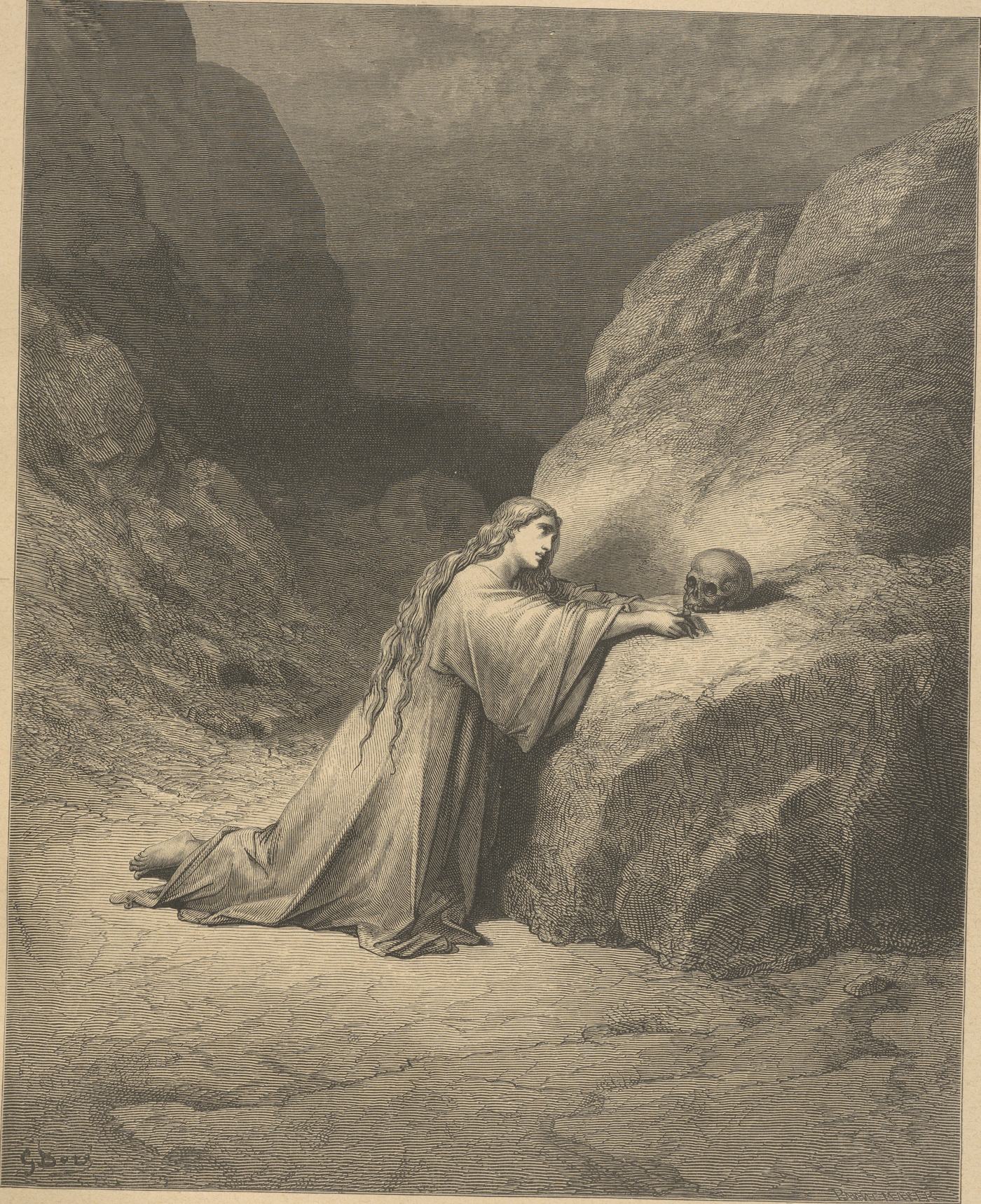
Mary Magdalene Repentant
Gustave Doré, 1866 · Luke 8:2
The passage
And certain women, which had been healed of evil spirits and infirmities, Mary called Magdalene, out of whom went seven devils,
Luke 8:2
About this plate
A woman kneeling alone in a hollow of rock. Her hair is down her back in a long fall. One hand rests on a skull set on the stone ledge in front of her; beside it an open book. There is nothing else in the plate — no cave, no altar, no angel, just weathered rock, and a great deal of it.
The furniture is borrowed from centuries of paintings: the skull, the book, the loose hair. Doré keeps all three and removes everything that usually surrounds them, so what would be a devotional set-piece becomes a picture of somebody a long way from anywhere.
The verse is not a scene at all. Luke is listing the women who travelled with him, and she appears in a subordinate clause: Mary called Magdalene, out of whom went seven devils. That is the entire biography the gospel gives her at this point.
Everything else — the penitence, the wilderness, the hair — came later, from tradition. Doré draws the tradition, and the verse underneath it quietly declines to confirm any of it.
Swipe left or right for the next plate